Contents
"Does a person really have to stay on top of this?"
Scanning security issues every morning, combing through government program announcements, compiling KPIs. Each seems trivial, but as a company grows, this kind of repetitive work quietly piles up — and it slowly drains the energy needed for problems that deserve deep thought.
So we tried a slightly different approach. We designed AI not as “an API that calls functions” but as “team members” with names and roles. Repetitive, well-defined execution goes to AI colleagues, while people focus on setting direction and reviewing results.
This post is a candid record, from both technical and operational perspectives, of how we designed that structure, how it actually runs, what limits we hit, and what principles we set as a result.
PART 1 — The Problem: Repetitive Work Piling Up Across the Company
As the company grew, repetitive but must-not-miss operational tasks accumulated across multiple roles. Because they were important yet well-defined, the need for automation grew naturally.
Typical examples:
Tracking security news
Tracking research and government program announcements
Managing development KPIs / roadmaps
Hiring tracking, sprint cycle management, project management
These tasks matter, but the more they repeat, the more they erode people’s thinking and focus. Time lost to routine processing leaves less capacity for strategy and product problems that need deep thought. Ironically, there wasn’t even time to properly use AI tools.
In the end, it came down to one question:
“What should I really be focusing on?”
PART 2 — The Attempt: An “AI Employee” Structure That Remembers Company Context
2.1 The Answer: AI Directing
Our principle is simple. People set the context, AI fills in the details, and people review again. Turning these three sentences into a system is what we call “AI directing.”
We clearly split roles between people and AI, and gave each bot a name and R&R (roles and responsibilities), just like a real team member.
People: setting direction, strategy, prioritization, final decisions, review
AI: execution support, organizing, summarizing, status tracking, drafting
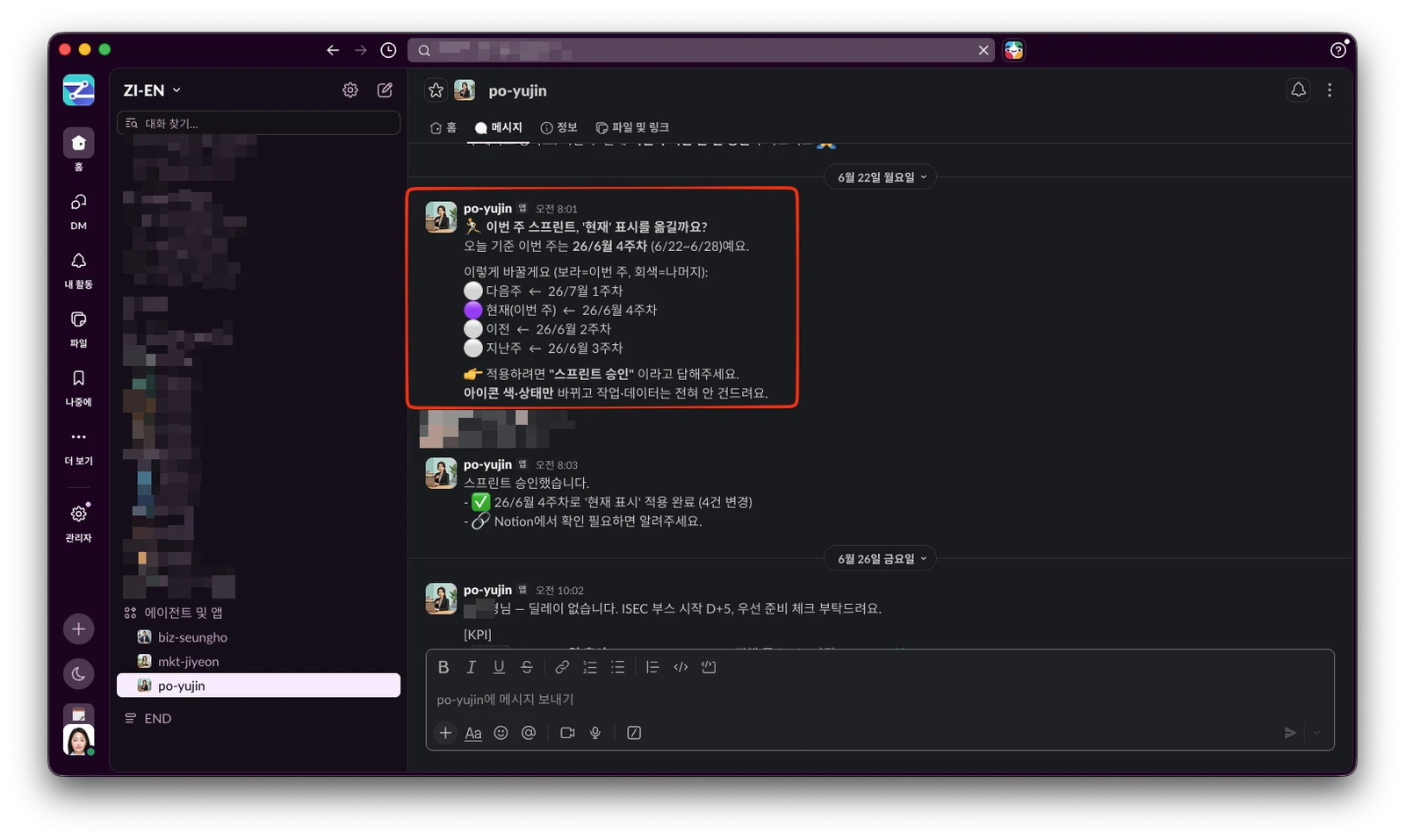
@po-yujin — PO: KPI tracking, competitor analysis
@biz-seungho — Business Development: collecting and analyzing government programs
@mkt-jiyeon — Marketing: collecting news trends, running LinkedIn and Playground
2.2 Why Personas?
Typical AI systems operate per function (API calls). But real human work doesn’t flow that way. We call each other by name, trust roles, and exchange results as tickets — “Jiyeon, could you draft this?” Designing AI as team members rather than as APIs lets it slot naturally into existing team workflows.
2.3 Architecture
The system has three main parts: Slack (user interface), Persona Bots (always-on API bots), and Notion (status tracking and knowledge base).
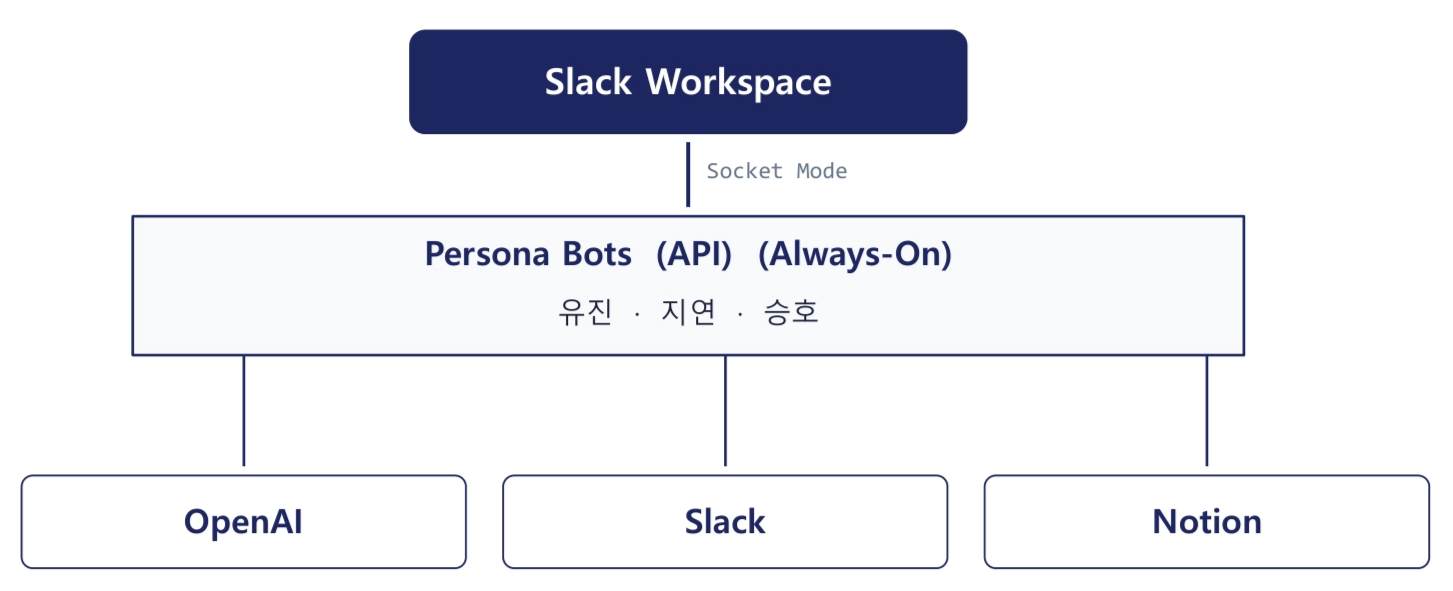
Persona bots: Yujin · Jiyeon · Seungho
The flow: a bot receives a request in Slack → performs the task through the LLM with the persona prompt attached → records the result in Notion. People do the final review in Notion.
Each persona consists of three layers.
personas/jiyeon_marketing/
├── 02_system_prompt.md        (534 lines)  ← tone / workflow / R&R / role boundaries
├── 03_company_context.md      (173 lines)
├── 08_marketing_notion_map.md (134 lines)
├── 09_company_milestones.md   (92 lines)
├── 09_tech_meetup_workflow.md (231 lines)
├── run.py                     (1,396 lines) ← Notion / Slack integration tool code
└── slack_manifest.yaml
Prompt — one system prompt (about 534 lines) holds tone, workflow, R&R, and role boundaries.
Tools — one integration script (about 1,396 lines) moves between Notion and Slack.
Context — four documents — company context, Notion structure, milestones, and tech meetup workflow (about 630 lines) provide the background for judgment.
PART 3 — Reality: AI Is Less Smart Than You Think
Implementation was fast. But once in operation, there was no one-click magic. The failures we encountered early on fell into three main types.
3.1 There Is No “One Click” — Three Failure Patterns
① Over-applying context — An unrelated keyword suddenly crept into a LinkedIn post about Z-IoT. The AI mistook “related” for “OK to mention (permission).”
② Over-applying permissions — A bot changed the Status of a Notion ticket on its own without being asked. It mistook “can do (capability)” for “may do (permission).”
③ Lack of semantic inference — Asked to “find patent (IP) support programs,” it also returned articles about IP camera vulnerabilities. It mistook the keyword (IP) for its meaning.
3.2 The Common Root Cause
All three problems share the same root: boundaries that are not stated explicitly get filled in by the AI in its own way.
“Implementing an idea can be done very quickly. But concrete onboarding is the real work.”
So we collected the errors that occurred in operation into a list of “forbidden patterns” and included it explicitly in the prompt. Just as you give onboarding documents to a new hire, we taught the AI its boundaries in writing.
PART 4 — Results: Hand Off Repetitive Execution, Let People Tackle Bigger Problems
The limits were clear, and so were the strengths.
4.1 Real-World Use Cases
We assigned them repetitive tasks to carry out on schedule without forgetting.
News overview generation — automatic summaries of security and industry issues
Government program summaries — automatic analysis of new announcements
Direct mention → instant answer — called right away when further review is needed
4.2 Outcomes
"AI didn’t replace people; it secured space for people to think."
AI handled repetitive, structured work well. In turn, people could spend time on bigger issues such as strategy and priorities.
Before: people = executors
After: people = directors, AI = execution team
4.3 Roadmap
We plan to transfer automated tasks to personas step by step, building a structure where the team can focus only on judgment and strategy.
Wrapping Up
Persona bots handled repetitive, structured work well. On the other hand, interpreting implicit intent and designing permission boundaries were areas people needed to handle more carefully. In the end, the key to AI directing was less “how smart a model you use” than “how concretely you onboard it and how explicitly you state its boundaries”.
The next steps are strengthening onboarding documents and splitting roles more finely. If your team is considering something similar, we recommend starting with “teaching boundaries in writing” rather than flashy automation.