Part 1: EU Cyber Resilience Act (CRA) - A New Security Standard for the Digital Era

- 01 Part 1: EU Cyber Resilience Act (CRA) - A New Security Standard for the Digital EraNow reading
- 02 Part 2: EU Cyber Resilience Act (CRA) - 6 Core Elements Companies Must Establish for CRA ComplianceRead →
Contents
1. What is the CRA?
The Cyber Resilience Act (CRA) is one of the EU’s most significant cybersecurity regulations, requiring manufacturers of hardware and software with digital components to ensure product security throughout its entire lifecycle.
More than a technical compliance framework, CRA formally establishes the principle that: “Security must be ensured from product design to end of life.”
CRA applies to any product containing digital elements (PDE), including laptops, smartphones, routers, sensors, cameras, firmware, mobile apps, game software, GPUs, CPUs, and cloud-based components.
💡 Why did CRA emerge?
The rapid surge in IoT adoption has resulted in increased security incidents due to device vulnerabilities and insufficient update policies.
Estimated global cybercrime cost by 2025: $10.5 trillion (average annual growth ~15%; Cybersecurity Ventures projection, 2020)
Estimated number of IoT devices by 2030: 30.2 billion (108% increase from today’s 14.5 billion)
As insecure digital products continue to proliferate, risks to individuals, organizations, and national infrastructure grow.
CRA was introduced to address this challenge with a structured, enforceable framework.
2. Who and what does the CRA apply to?
2.1 Product scope: PDE (Products with Digital Elements)
A PDE is not just a standalone device—it also includes embedded software, digital modules, and even cloud or remote services directly involved in product operation.
CRA applies to:
Hardware (e.g., laptops, CCTV cameras, industrial IoT devices)
Embedded firmware and operating systems
Digital components sold separately (e.g., sensors, security chips, software modules)
Remote data processing features (e.g., cloud-based update and monitoring services)
2.2 Entities subject to CRA
CRA extends beyond manufacturers and includes stakeholders across the entire supply chain.

🚫 Excluded from CRA:
Products used for defense or national security
Sectors already under separate regulation (e.g., automotive, medical, aerospace, marine)
Non-commercial open-source software (unless commercially distributed or embedded)
2.3 Product classification and conformity assessment
Products are classified based on risk level, which determines the required conformity assessment module.
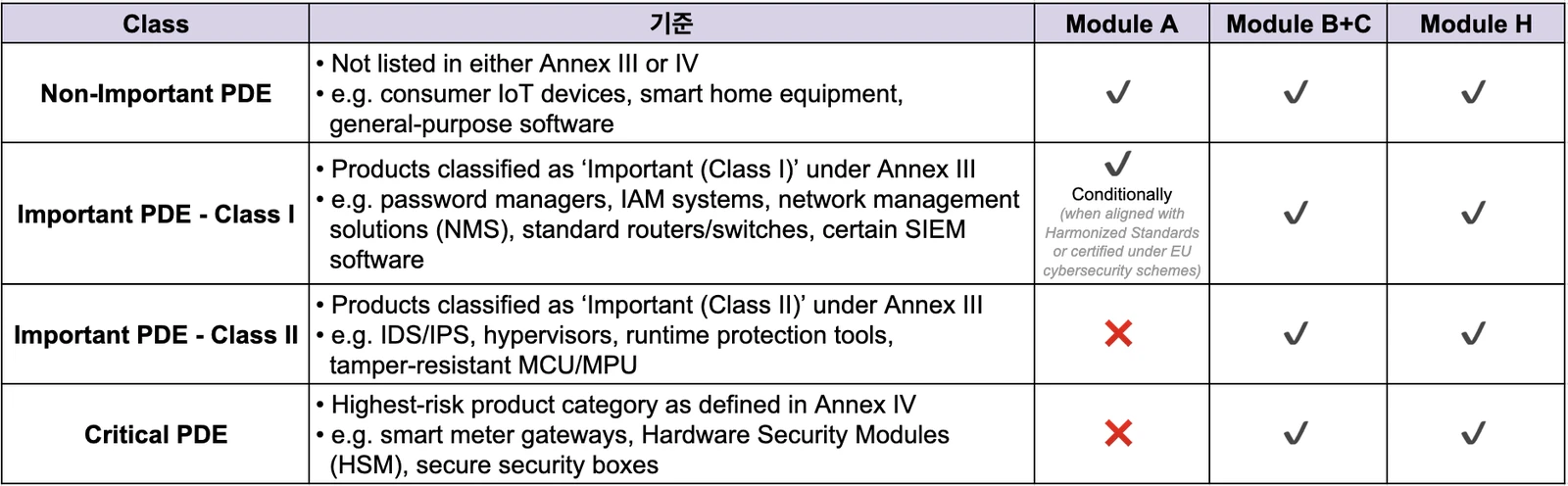
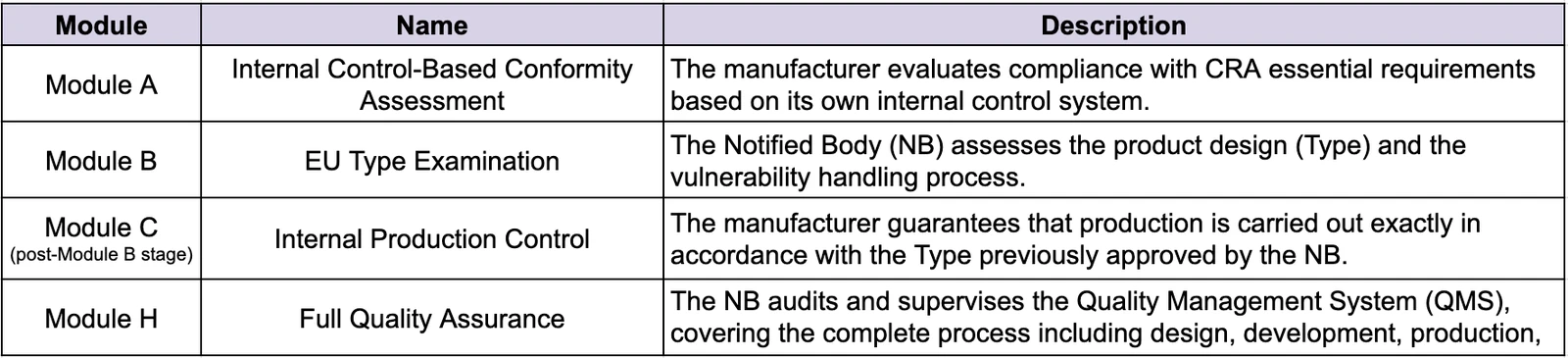
ℹ️ Conformity assessment modules
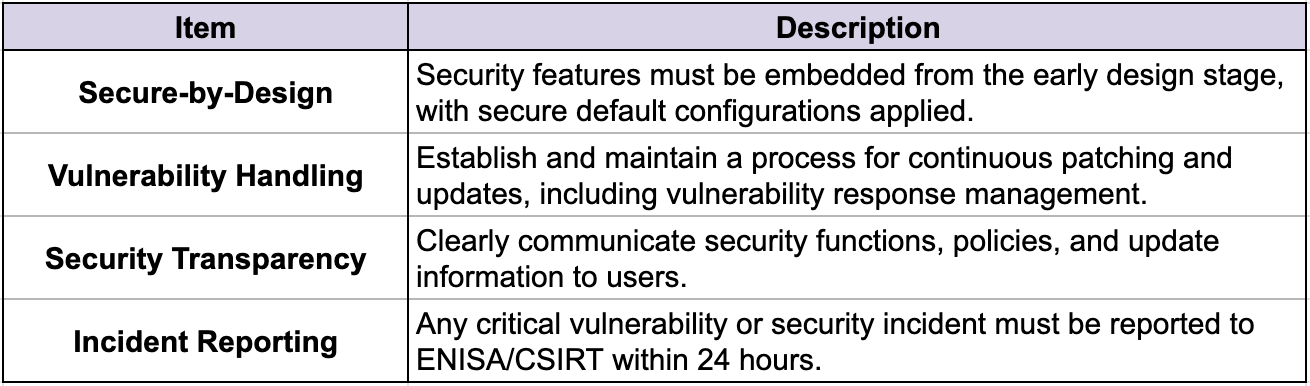
3. CRA Security Requirements
All PDE products placed on the EU market must meet these four core security requirements:
4. Non-compliance penalties
CRA follows an enforcement model comparable to GDPR and extends liability across the entire digital supply chain.
Fines: Up to €15 million or 2.5% of global annual revenue — whichever is higher
Market restrictions: Suspension from EU market, recalls, or distribution bans
Supply chain responsibility:
Manufacturers must conduct due diligence on third-party components
Even non-EU providers must comply if their components are used in products entering the EU
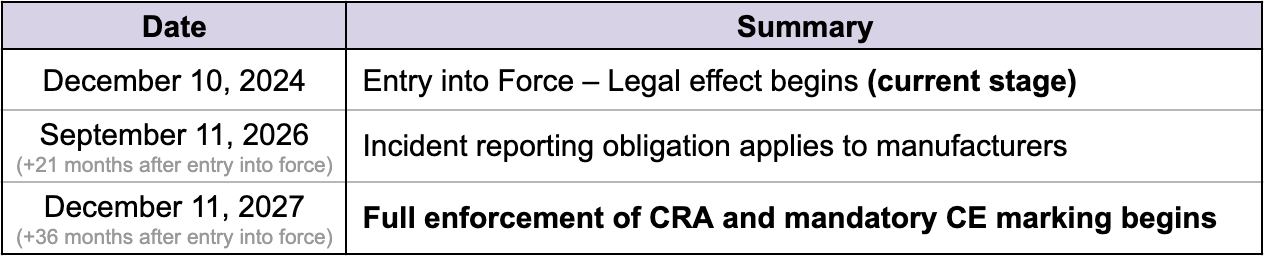
5. CRA Implementation Timeline
After the CRA enters into force, a transitional period is granted.
Manufacturers must begin reporting cybersecurity incidents 21 months post-enforcement, representing the first mandatory compliance milestone.
6. Final Insight: “CRA is not about compliance. It’s about survival.”
CRA mandates that security must be built into the entire product lifecycle, not added post-development.
This applies not only to global enterprises but any organization entering the EU market.
“Only products that are secure from design to end-of-life will remain viable in the market.”
Organizations must be capable of demonstrating competence in: risk assessment, SBOM, vulnerability management, technical documentation, user communication, and incident reporting.
The CRA’s vulnerability and incident reporting obligations have applied since September 11, 2026, and the remaining obligations apply in full from December 11, 2027. Preparation is multifaceted—and cannot be achieved in a single effort.
🔜 Next (Part 2): “6 Core Elements Companies Must Establish for CRA Compliance”
Part 2 outlines the required strategic and technical foundations for CRA compliance, providing a practical checklist and prioritization roadmap.
📌 Need support building CRA readiness strategies or preparing technical documentation?
ZIEN’s security and regulatory experts can help develop your approach.

🔗 https://zi-en.io/company/contact-us
<Reference> Official Cyber Resilience Act website (https://www.cyberresilienceact.eu/)